
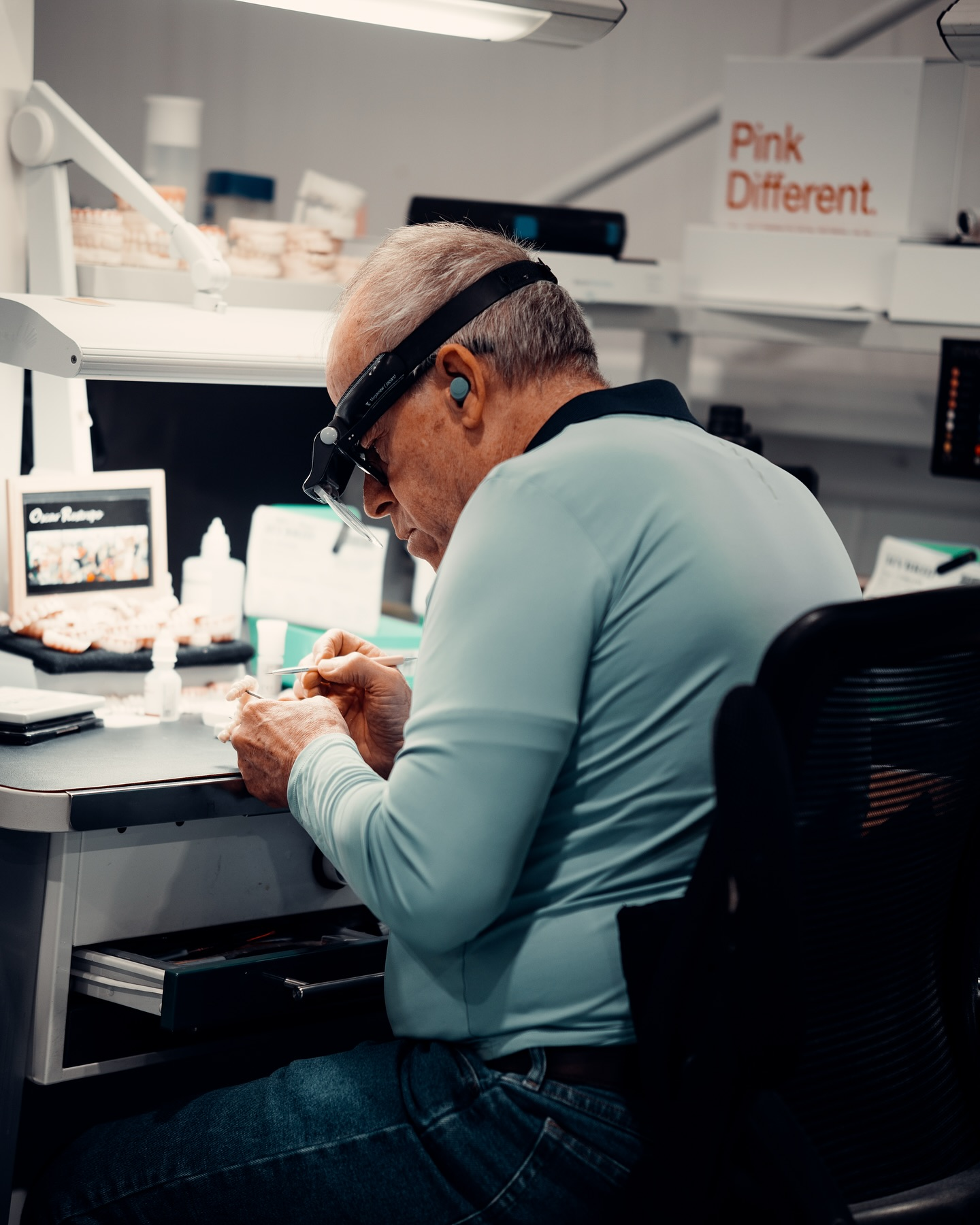
Chris Bell, CDT, a master ceramist and technical director at Midwest Dental Arts, has been helping dentists deliver exceptional restorative and aesthetic results for nearly 30 years. With a deep background in advanced dental education — including work with Dawson, Spear, Pankey, and Ross Nash — Chris has seen almost every challenge that comes with planning, designing, and delivering complex cases.
And if there’s one thing he’s learned, it’s how important clear, consistent communication is between dentist and lab.
“I’ve been working with Dawson Academy doctors since 2005,” Chris shared. “That’s when I first got introduced to Smile Wizard. From day one, I saw how powerful it was for keeping everything organized and on track. As a lab guy, it’s just as valuable to me as it is to the doctor because it gives me access to everything I need to make their case succeed.”
Chris oversees operations for Midwest Dental Arts across their Florida, Iowa, and Connecticut locations. He works with dentists at all levels, but especially those trained in advanced occlusion and smile design. One of the biggest barriers he sees to great outcomes? Lack of a systematic, organized approach.
“When doctors don’t use Smile Wizard, they’re usually piecing things together — a paper checklist here, some notes scribbled in a chart, photos emailed to me in no particular order,” he said. “It slows everything down and increases the chances of something getting missed. Smile Wizard keeps it all in one place, step by step, so the doctor stays on track and I can see everything I need. That level of clarity makes a huge difference.”
One of the most helpful features, Chris says, is how Smile Wizard organizes photos and critical records. “For me, the photos are huge,” he explained. “The way Smile Wizard propagates them in the right sequence — and keeps them tied to the patient’s history and treatment plan — means I can design and fabricate restorations that correct, rather than replicate, pre-existing problems. I can see where the case started, where it’s going, and make sure I don’t create any new interferences. That’s a big deal when you’re trying to deliver high-end aesthetic and functional results.”
Chris recalled a case with a doctor in Phoenix where Smile Wizard helped avoid a major misstep. “We had a patient who initially planned on implants in the posterior,” he said. “But when I reviewed the Smile Wizard notes, I saw documentation about poor bone density in that area. We ended up shifting to a partial with attachments instead — and avoided a plan that would have likely failed. Without that information clearly recorded and easy to access, it would have been easy to miss.”
In addition to improving communication, Chris has seen how Smile Wizard helps doctors stay disciplined throughout the process. “Every dentist I know who uses it says the same thing: it keeps them on track,” he said. “It literally won’t let you skip steps. You can’t move forward until you’ve completed the step before. And that structure prevents the kind of mistakes that can throw an entire case off.”
Chris himself has experience with multiple leading dental philosophies, including Dawson, Pankey, Spear, LVI, and Ross Nash’s programs. He’s quick to point out that Smile Wizard isn’t limited to one particular philosophy.
“It doesn’t matter if you’re Dawson-trained, Spear-trained, or you learned somewhere else,” he said. “The fundamentals are still the same — good records, organized data, proper proportions, clear documentation. Smile Wizard gives you all of that, no matter your philosophy. It just works.”
On the lab side, Chris also sees value in how Smile Wizard keeps him aligned with the doctor throughout the treatment process. “We’ll often jump on Zoom and review the case together, both looking at the same photos and data in Smile Wizard,” he explained. “Sometimes I’ll even overlay a design on the patient’s photos pulled from Smile Wizard so we can see exactly how it fits in their smile line. Being able to collaborate like that — with all the same information in front of both of us — makes the case much more predictable and successful.”
Chris is also a strong advocate for dentists new to comprehensive dentistry to start using Smile Wizard early. “If you’re just starting out, it can feel like a big investment,” he acknowledged. “But as I tell doctors all the time, it only takes closing one good case to pay for it. And after that, it just keeps paying off — because you’re more organized, you present cases better, and your results improve.”
Ultimately, Chris sees Smile Wizard as an indispensable tool in modern dentistry. “It keeps everyone — dentist, lab, and patient — on the same page,” he said. “It keeps cases predictable, organized, and successful. At the end of the day, that’s what we all want: great results for the patient and a seamless process for everyone involved.”